Showing posts with label Astronomy. Show all posts
Showing posts with label Astronomy. Show all posts
Sunday, February 01, 2009
Friday, May 30, 2008
(Almost) Live From Mars
Now this is amazing! The Mars Reconnaissance Orbiter snapped this lovely shot of the Phoenix Lander parachuting to the surface of Mars. Technology these days, very cool!
Check out the box in the lower left of the image, you can clearly make out the chute as well as the Lander underneath. Source: Astonomy Picture of the Day
Monday, March 03, 2008
Shadow In Shadow
by Alex Mukensnable
 This is an awesome view of the lunar eclipse as seen from Hawai'i within the shadow cast by Mauna Kea on the distant atmosphere. I found it on Astronomy Picture of the Day.
And the full movie from Alex's site. Very nice.
Thursday, February 14, 2008
Happy Valentine's Day!
I typically do not pay attention to Valentines Day since only once in my life have I actually been dating someone when the day arrives. Even then, our relationship was on the fritz so it really wasn’t a romantic day after all.
Anyway, I saw this on the Astronomy Picture of the Day site and thought it was pretty cool; see, I do have a romantic streak; I just don’t have anyone to show it to. Yeah, I know, poor me.
I’ll just reproduce what they wrote below.
Long Stem Rosette
Explanation: The Rosette Nebula (aka NGC 2237) is not the only cosmic cloud of gas and dust to evoke the imagery of flowers. But it is the one most often suggested as a suitable astronomy image for Valentine's Day. Of the many excellent Rosette Nebula pictures submitted to APOD editors, this view seemed most appropriate, with a long stem of glowing hydrogen gas in the region included in the composition. At the edge of a large molecular cloud in Monoceros, some 5,000 light years away, the petals of this rose are actually a stellar nursery whose lovely, symmetric shape is sculpted by the winds and radiation from its central cluster of hot young stars. The stars in the energetic cluster, cataloged as NGC 2244, are only a few million years old, while the central cavity in the Rosette Nebula is about 50 light-years in diameter. Happy Valentine's Day!

Friday, July 20, 2007
Galaxy Zoo

Have you ever wanted to be an astronomer but didn’t really have the time or money to feed that hobby? Well, now you can!
The good folks over at Galaxy Zoo have created a program that enlists the help of us human computers on the web (it’s along the lines of what SETI did but instead of using your computer, they use you). Basically, real computers can’t (as of yet) determine details as well as their human counterparts. As a result, they need us to help classify the multitudes of galaxies that have been imaged.
Yes, it gets kinda boring after awhile but you can see some pretty cool galaxies that no one else has seen yet. Isn’t the universe an awesome place!
So, if interested, head over there and give it a shot. You have to take a quick tutorial and test and then you are up and running.
The good folks over at Galaxy Zoo have created a program that enlists the help of us human computers on the web (it’s along the lines of what SETI did but instead of using your computer, they use you). Basically, real computers can’t (as of yet) determine details as well as their human counterparts. As a result, they need us to help classify the multitudes of galaxies that have been imaged.
Yes, it gets kinda boring after awhile but you can see some pretty cool galaxies that no one else has seen yet. Isn’t the universe an awesome place!
So, if interested, head over there and give it a shot. You have to take a quick tutorial and test and then you are up and running.
Tuesday, March 27, 2007
Here's Looking At You.
Ever get that feeling you are being watched? This is actually a storm at Saturn's south pole.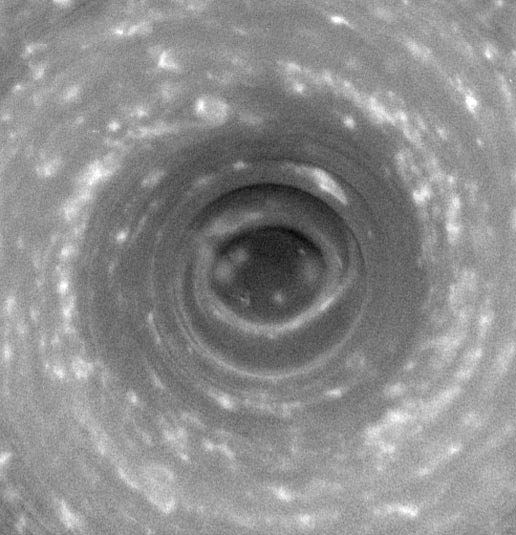 Credit: NASA/JPL/Space Science Institute
A 5,000-mile-wide hurricane-like storm swirls at Saturn's south pole. Note the well defined eye.
Thursday, December 21, 2006
The Active Sun
Credit: Solar Optical Telescope, Hinode Satellite, JAXA
Another cool shot. I wonder if my current fascination with the sun has anything to do with the fact that it's so damn cold up here these days; duh, it’s like uh, winter?! Deal with it!
Maybe a trip to Hawai’i is in order. I think I'll start a "Send-Rob-to-Hawai'i" charity fund (right after I start that "Buy-Rob-a-new-computer" fund).
Wednesday, December 13, 2006
Moreton Wave
(A Tsunami On The Sun)
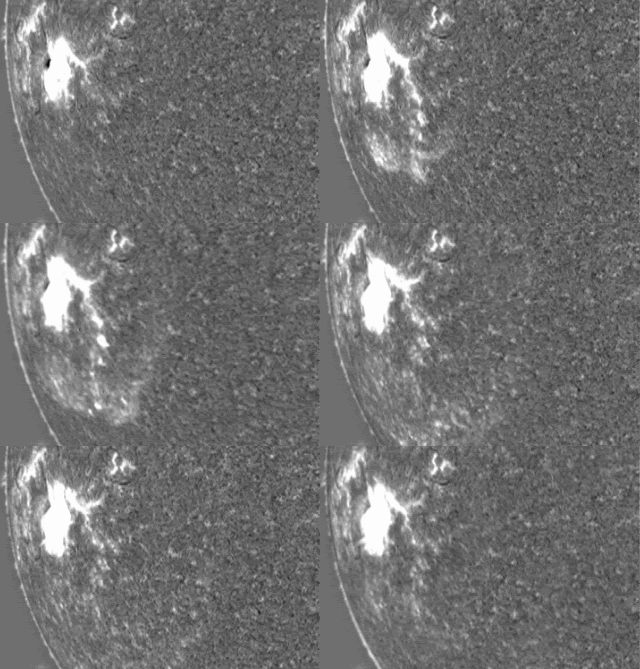 How cool is this!?
This imagery is shown on Astronomy Picture of the Day and titled, A Large Tsunami Shock Wave on the Sun.
According to the site,
"The rampaging tsunami took out some active filaments on the Sun, although many re-established themselves later. The solar tsunami spread at nearly one million kilometers per hour, and circled the entire Sun in a matter of minutes."
Friday, August 18, 2006
What’s in a name? Defining a planet.
So astronomers are finally trying to sort out the planet definition thing. It’s about time if you ask me. However, many want to keep the traditional 9 planets for sentimental reasons not scientific.
I find humans funny in this regard; always trying to hang on to the past even though it is proven to be incorrect. They go kicking and screaming into the future and refuse change.
While I have not spent much time researching and thinking about what I’d do with regard to Pluto and all the other objects recently discovered, I can tell you, I would not keep the traditional 9; that would be like continuing to call the Earth flat long after it was proven to be round.
Subscribe to:
Posts (Atom)